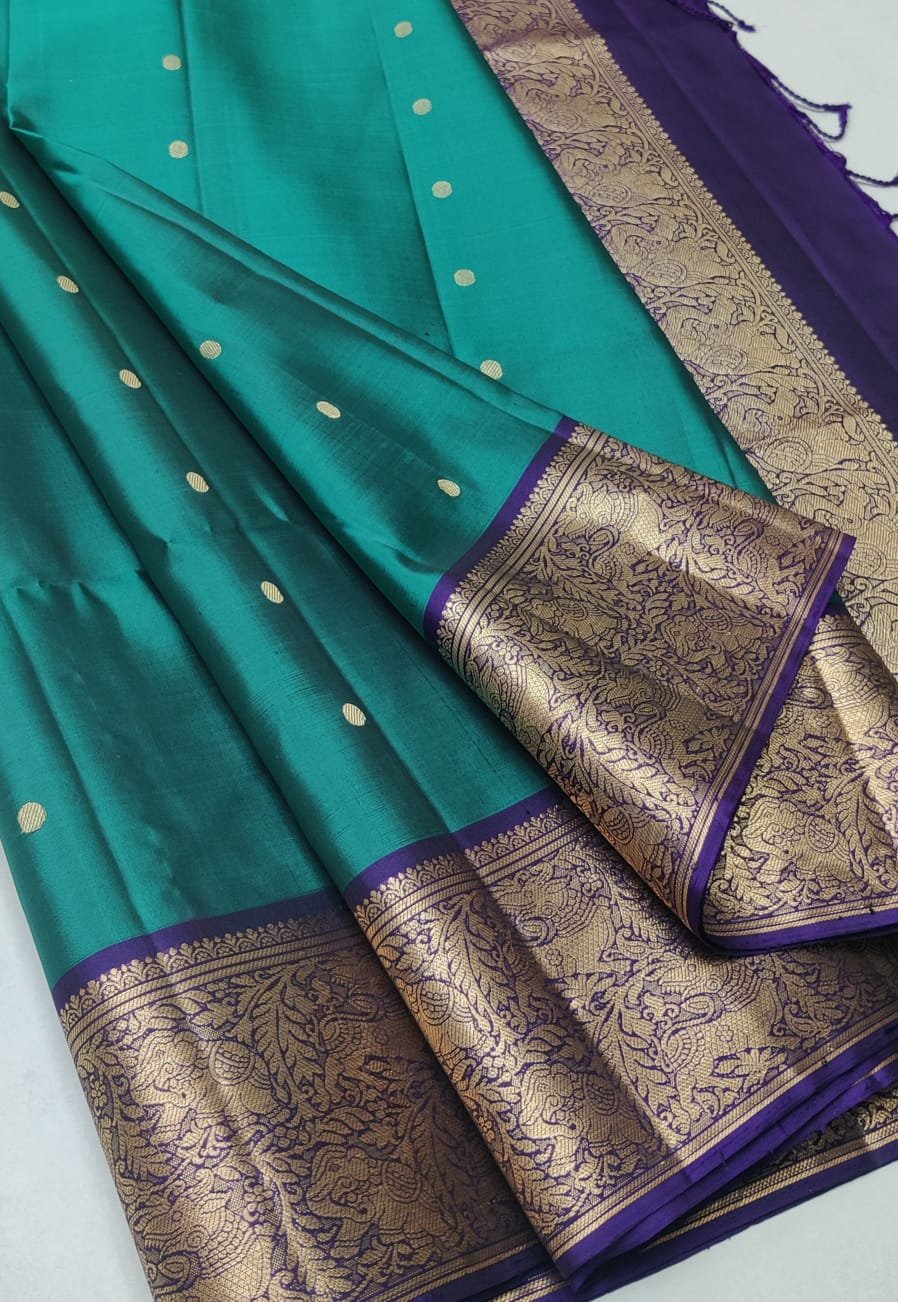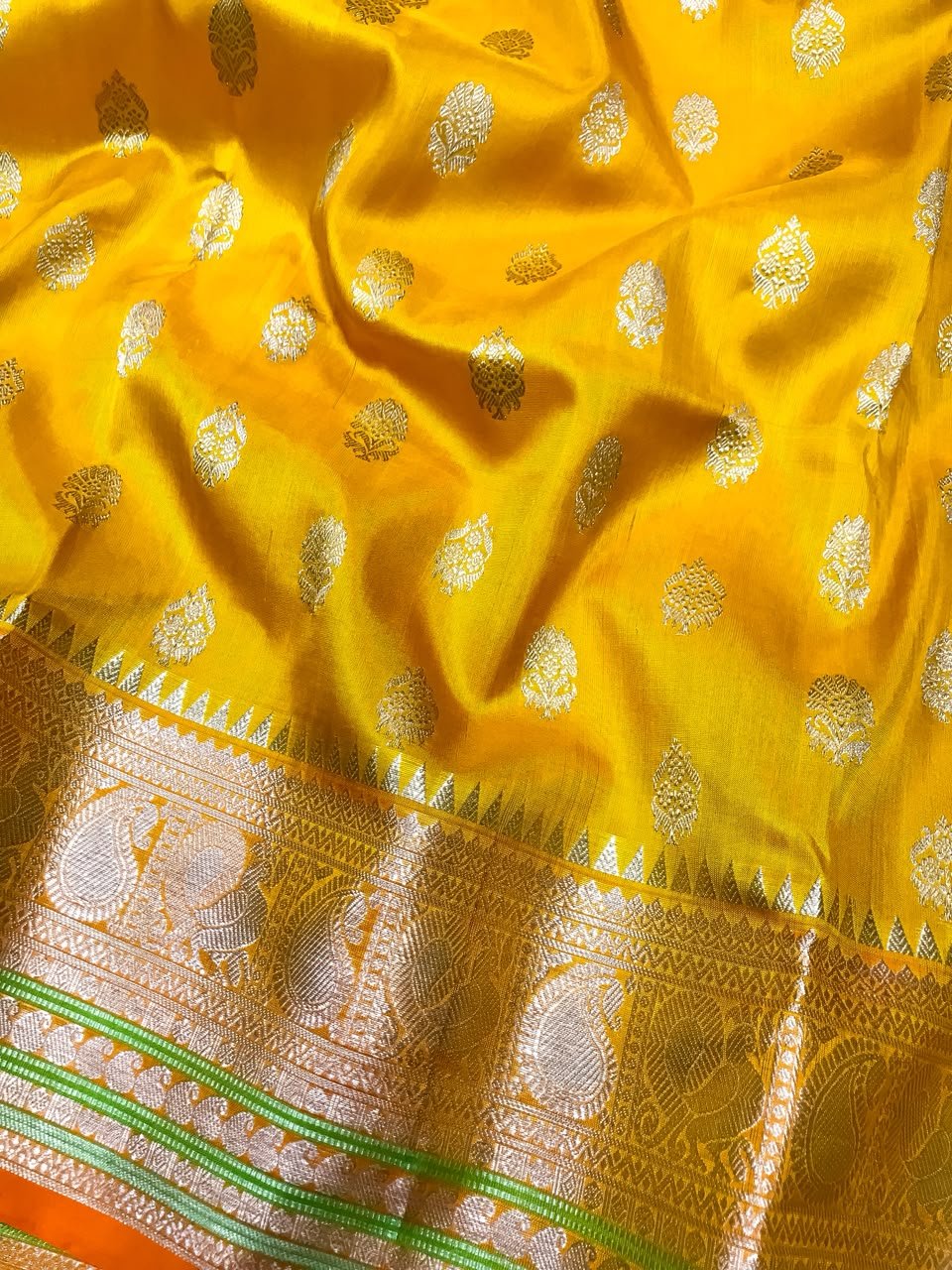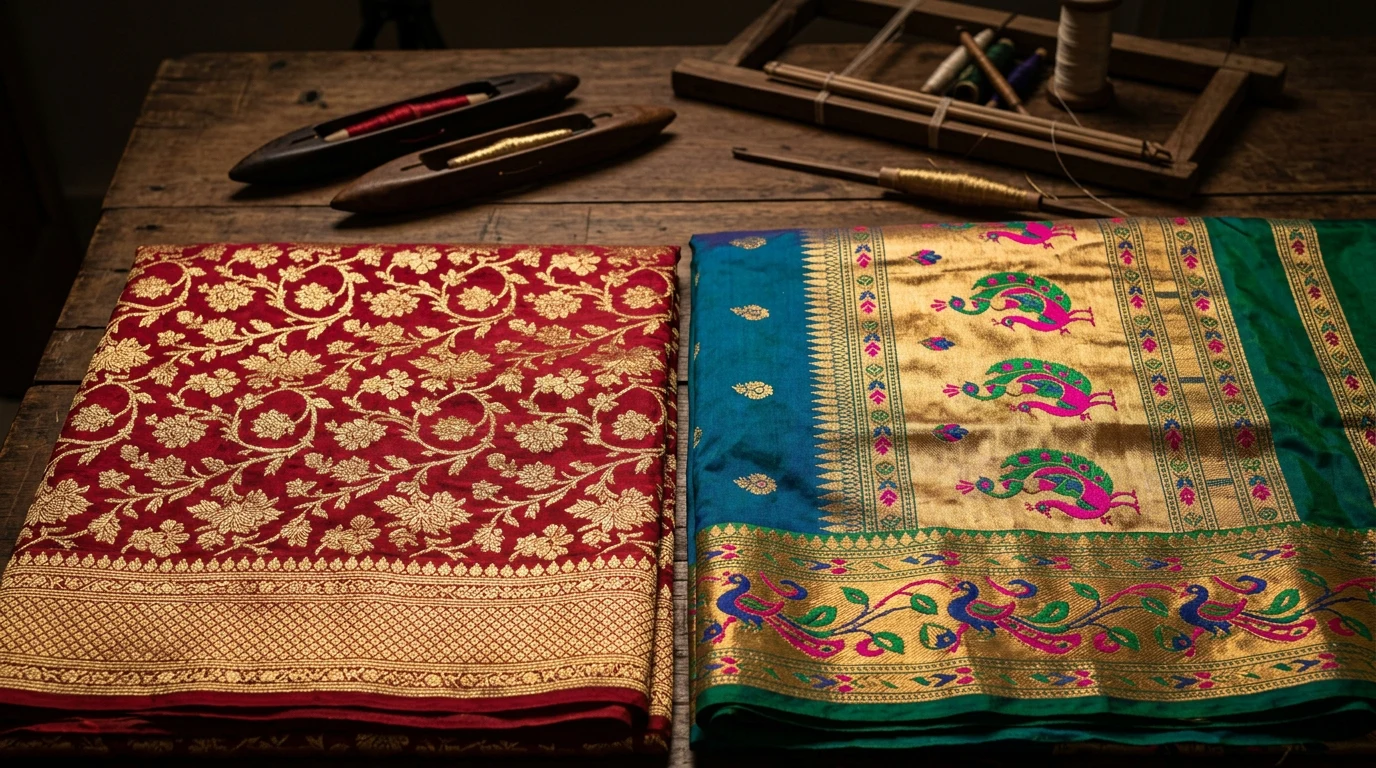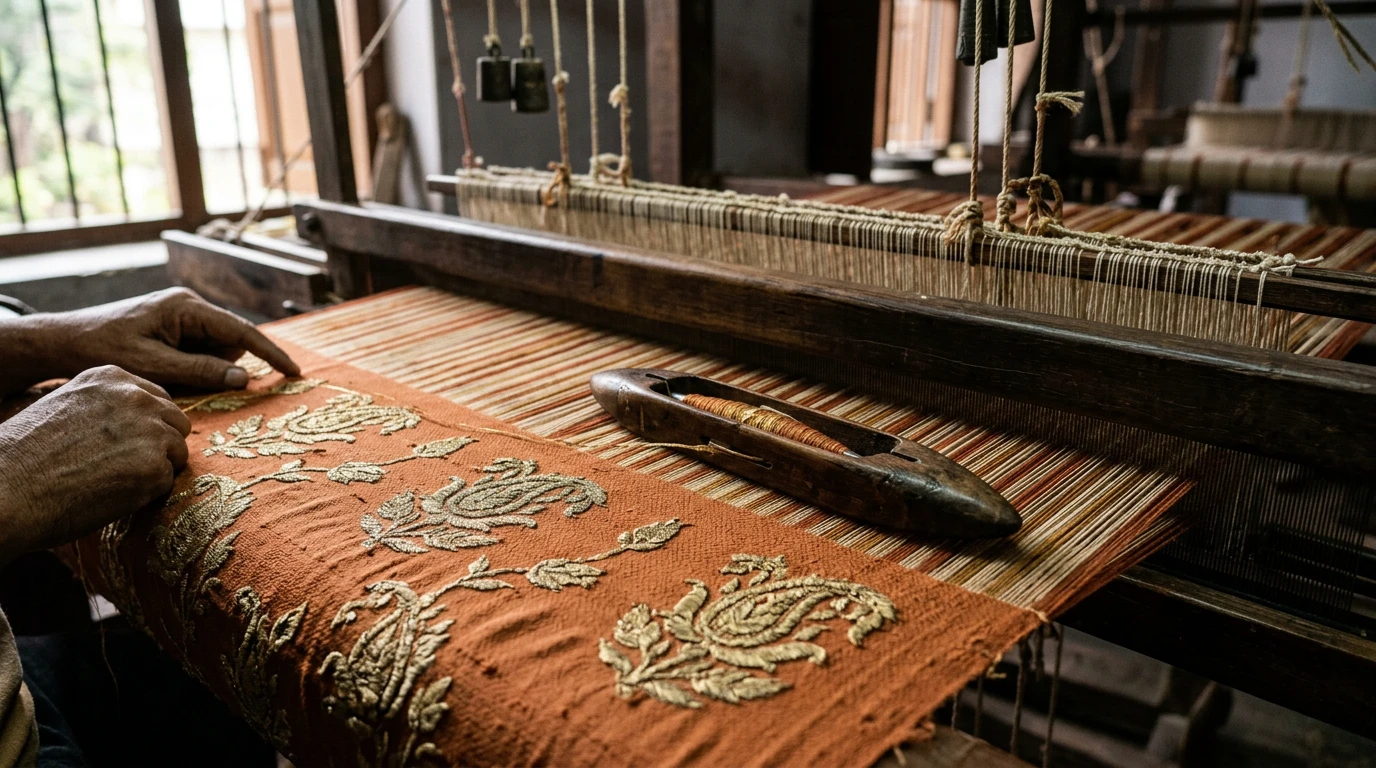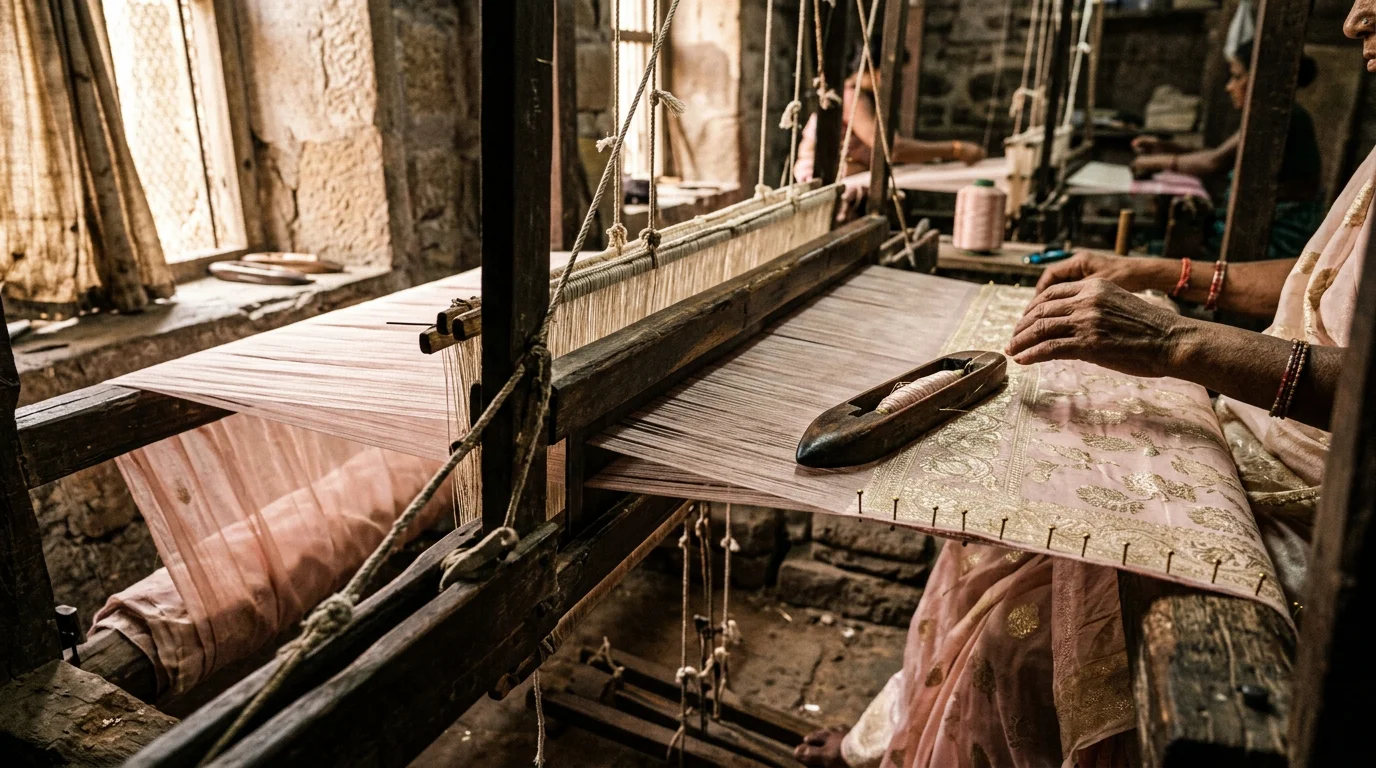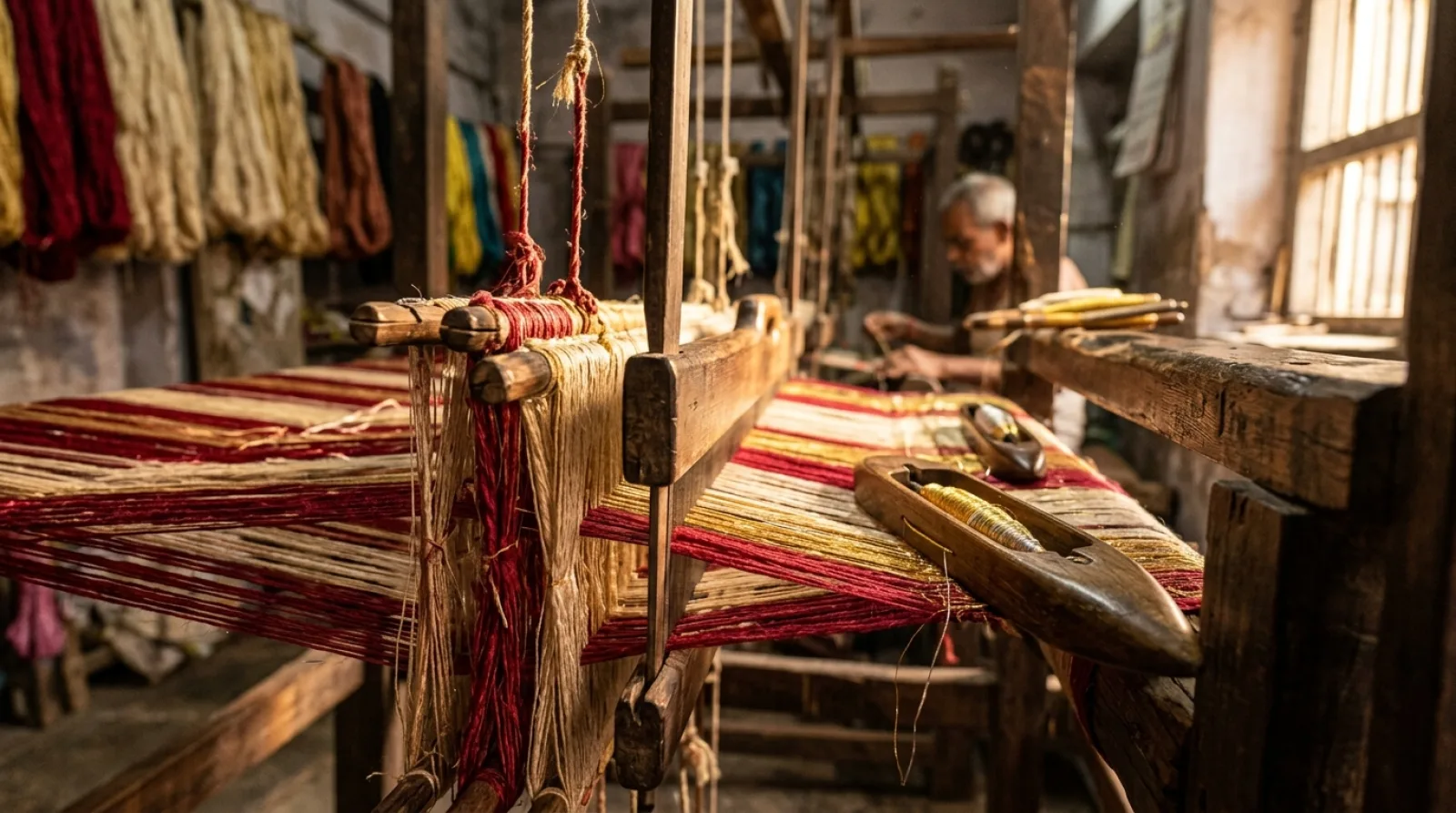
Katan silk is a plain-woven, ultra-durable luxury textile crafted by doubling and tightly twisting pure mulberry silk filaments together before mounting them on the loom. Renowned as the royal foundation of Varanasi handlooms, this high-twist yarn architecture produces an exceptionally dense, luminous fabric with a crisp structural drape, unrivaled tensile strength, and generational longevity.
Walk through the ancient weaving mohallas of Madanpura, Chowk, or Peeli Kothi in Varanasi at dawn, and you will hear the rhythmic click-clack of wooden pit looms echo against stone walls. Here, our master weavers hold a sacred respect for Katan. In an era where powerloom mills flood showrooms with synthetic polyester "art-katan" at ₹2,500, discerning brides and heirloom collectors must know what true handloom Katan represents: months of human patience, pure sericulture, and architectural yarn tension.
Yarn Construction: 2-ply twisted mulberry silk (20/22 denier) in both warp (Tana) and weft (Bana).
Tensile Character: High twist count (22–28 TPI) yielding crisp structural body, zero slippage, and high durability.
Authenticity Hallmark: Pure Silk Mark India certified, organic ash burn test, and natural selvage tenter pin-marks.
What Is Katan Silk? Etymology & Yarn Anatomy
The word Katan originates from the Persian word Katān, historically referring to fine woven threads. In the lexicon of Varanasi handlooms, Katan specifically denotes a yarn-twisting methodology rather than a simple weave pattern.
Unlike soft, untwisted silks like raw Tussar or crepe, genuine Katan is born from high-grade pure mulberry silk (Bombyx mori). Filaments reeled from cocoons are doubled—taking two or more single raw threads—and spun with a precise twist count on traditional twisting frames. This mechanical twisting locks the silk fibroin proteins tightly in place, creating a thread of extraordinary tensile strength that withstands the rigorous pounding of the handloom reed.
The Secret of Tana (Warp) & Bana (Weft) Tension
A Banarasi saree’s longevity depends entirely on how the warp and weft interact under tension:
- The Warp (Tana): The lengthwise skeleton of the loom. Handloom Katan warp requires tightly twisted, uniform 2-ply 20/22 denier mulberry yarns spaced at 120 to 140 ends per inch (EPI). This dense warp prevents sagging and supports the weight of heavy silver zari motifs.
- The Weft (Bana): The crosswise shuttle yarn. Handloom Katan weft uses slightly lower-twist 2-ply silk (84 to 110 picks per inch). When beaten firmly into the warp by the weaver’s wooden sley (hathha), the weft flattens gracefully, creating that signature subtle pearlescent sheen without artificial gloss.
Technical Fabric Specification Card: Handloom Katan Silk
Pit Loom vs. Powerloom: Why Genuine Katan Feels Different
A genuine Banarasi Katan saree cannot be replicated on high-speed powerlooms without sacrificing soul and structural grace. On a traditional pit loom (Gaddha loom), the loom frame is excavated three feet into the cool earth.
This subterranean humidity keeps natural silk filaments supple, preventing brittle breakage during weaving. The master weaver operates wooden foot treadles (khatka) with physical intuition, micro-adjusting warp tension with every pass of the shuttle.
By contrast, industrial shuttleless rapier looms shoot weft threads at violent velocities. Because pure mulberry silk filaments would snap under such mechanical stress, powerloom mills either coat yarns in chemical starches or blend the silk with synthetic polyester and nylon filaments. The result is a stiff, glassy imitation that traps body heat and crumbles at the folds after two seasons.
| Evaluation Parameter | Pure Handloom Katan Silk | Powerloom Poly / Art Replica | Semi-Katan Viscose Blend |
|---|---|---|---|
| Yarn Composition | 100% 2-ply twisted mulberry silk | Polyester / Nylon filament blend | Regenerated cellulose / Viscose mix |
| Loom Source | Varanasi Pit Loom (Manual Treadle) | High-speed Surat/Surat Rapier Mill | Semi-automatic Machine Loom |
| Luster & Reflection | Subtle, multi-angled pearlescent glow | Harsh, mirror-like artificial shine | Flat sheen; dims after first dry clean |
| Reverse Side Finish | Hand-locked motifs or clean continuous floats | Fuzzy mechanical cut-fringe (scratchy) | Sparse cut threads; prone to snagging |
| Selvage Edges | Organic woven selvage with tenter pin-marks | Heat-sealed or laser-cut fused border | Uneven machine selvedge with frayed fibers |
| Thermal Breathability | Adaptive natural protein; cool in summer, warm in winter | Suffocating synthetic; traps sweat and static | Moderate; limp when exposed to humidity |
| Generational Lifespan | 50 to 100+ years (True Heirloom Asset) | 1 to 3 years before yarn fraying | 3 to 5 years; weakens at creases |
| Fair Market Price (INR) | ₹25,000 – ₹1,80,000+ | ₹1,800 – ₹5,500 | ₹6,000 – ₹12,000 |
Hands-on Inspection: 4 Physical Tests to Verify Pure Katan
Before investing in a bridal Banarasi, do not rely solely on verbal showroom assurances. As master weavers, we instruct every collector to perform these four physical inspection checks.
1. The Reverse Side Float & Lock Check
Flip the saree over and inspect the back of the floral motifs (bootas). In an authentic Kadhua Katan saree, each motif is woven individually with a bamboo spool—there are zero loose threads spanning between motifs.
In an authentic Fekwa handloom, you will see a continuous extra weft yarn running across the back, which is soft to the touch and woven into the fabric. If you see thousands of tiny, spiky, mechanically clipped thread ends like a short haircut, the saree was produced on a powerloom cutwork machine. Those clipped edges will snag on your jewelry and irritate sensitive skin.
2. The Loom Pin-Hole Check (Kanji Marks)
Examine the solid woven edges (selvages) running along the length of the saree. A handloom pit weaver uses wooden tenter clamps with brass needle points (kanji or panna) to maintain consistent fabric width under tension.
Every 8 to 12 inches along the border edge, you will find tiny, faint organic needle pin-pricks. Powerloom fabrics, woven mechanically under roll tension, have perfectly smooth or heat-sealed plasticized selvages without these telltale artisan pin-marks.
3. The Snip & Burn Test
Request the merchant or snip 2 to 3 tiny fibers from the unfinished pallu fringe:
- Pure Katan Silk: Because silk is an animal protein fiber (fibroin), it burns slowly with a distinct odor of singed hair or burning feathers. It does not produce a continuing flame—when pulled away from fire, it self-extinguishes immediately. The residue forms a dark, brittle bead that crumbles effortlessly into fine black ash between your thumb and forefinger.
- Synthetic / Polyester Fake: Ignites aggressively, produces black chemical smoke with a pungent smell of burning plastic, and melts into a rock-hard, uncrushable bead that will burn your fingers.
4. The Chemical Solubility Test
For absolute laboratory-grade certainty, take a few fringe threads and drop them into a small cup of household liquid bleach (5% sodium hypochlorite) at room temperature.
Pure natural mulberry silk is an organic protein and will completely dissolve within 15 to 20 minutes, leaving the liquid clear. Artificial silk, viscose, polyester, and mercerized cotton threads will remain completely intact in the solution without degrading.
Real-World INR Pricing Benchmarks: What Should You Pay?
Handloom pure Katan silk is an artisanal product with fixed raw material costs. When budgeting for your trousseau or collector wardrobe, keep these transparent Varanasi artisan benchmarks in mind:
₹18,000 – ₹35,000
(Approx. $220 – $420 USD)
Handwoven pure Katan silk featuring clean Fekwa or Tanchoi weave motifs with electroplated tested zari. Ideal for formal celebrations and festive ceremonies.
₹40,000 – ₹85,000
(Approx. $480 – $1,050 USD)
Master handloom Kadhua weave where every boota is hand-locked individually on the pit loom. Rich tested or high-grade silver-gilt zari with clean reverse finishing.
₹90,000 – ₹2,50,000+
(Approx. $1,100 – $3,000+ USD)
Collector masterpieces including all-over Katan Jangla, antique Shikargah tapestries, or certified Real Zari (pure silver wire electroplated in 24k yellow gold).
If a vendor offers a "Pure Katan Silk Banarasi Saree" for ₹3,000 or ₹5,000, remember that the raw mulberry silk yarn alone required to warp and weft a standard 5.5-meter drape costs our weavers more than ₹6,500 before a single day of loom labor is paid. Anything below ₹15,000 is invariably a machine-made synthetic blend.
Experience Varanasi’s Purest Katan Silk
Every Sutvani saree is handwoven on traditional earthen pit looms by generational master artisans in Varanasi, certified with the Silk Mark India hallmark and backed by our lifetime authenticity guarantee.
Frequently Asked Questions
What is Katan silk made of?
Katan silk is woven from 100% pure mulberry silk filaments that have been doubled and tightly twisted together before weaving. This distinct twisting process creates a robust, 2-ply yarn for both warp and weft, giving the fabric its signature crisp body, pearlescent luster, and generational durability.
How do you identify a pure handloom Katan silk saree from a powerloom replica?
Look at the reverse side and the selvage edges. Authentic handloom Katan displays hand-locked threads (Kadhua) or continuous weft floats with hand-cut ends (Fekwa), accompanied by small pin-marks along the selvage from the loom frame. Machine-made powerloom replicas feature fuzzy, mechanically sheared cut-fringes on the back and stiff, heat-sealed selvages.
Does pure Katan silk feel stiff or soft?
Pure handloom Katan silk has a structured, crisp initial drape due to the high-twist yarns and natural silk proteins, but it softens quickly with body warmth without losing its regal silhouette. Unlike synthetic blends that feel slippery or plasticky, authentic Katan feels organic, breathable, and substantial in the hand.
What is the price range of an authentic handwoven Katan silk Banarasi saree?
Genuine handloom Katan Banarasi sarees begin at approximately ₹15,000 to ₹20,000 for simpler weaves and range from ₹35,000 to ₹1,50,000+ for intricate Kadhua, Jangla, or pure silver zari bridal heirlooms. Sarees marketed as "Katan silk" below ₹8,000 are almost universally machine-woven blends containing viscose, polyester, or art silk.
What is the HSN code for handloom pure Katan silk sarees?
The official Harmonized System of Nomenclature (HSN) code for woven fabrics of pure handloom silk is 5007, specifically sub-heading 5007 20 10 in India, which applies to fabrics containing 85% or more by weight of pure silk woven on handlooms.